
Procedure of Establishment of Company through Foreign Direct Investment (“FDI”) in Nepal
The article provides the general overview of procedure of establishment of Company through Foreign Direct Investment in Nepal.
1. Governing Laws of foreign direct investment in Nepal
The major law governing foreign investment in Nepal are as mentioned:
- Foreign Investment and Technology Transfer Act 2019 (2075) (“FITTA“),
- Foreign Investment and Technology Transfer Rule, 2020 (2076),
- Industrial Enterprises Act, 2020 (2076) (“IEA”),
- Foreign Exchange Regulation Act, 1962 (2019) (“FERA”) and
- Public Private Partnership and Investment Act, 2019 (2075) (“PPPAct”).
2. Approval Authorities for Foreign Direct Investment in Nepal
Foreign investment is subject to approval. Following are the authorities that provides FDI approval based on the investment amount:
Investment amount | Approving Authority |
For NPR 6 billion or Less | Department of Industry (“DOI”) |
Above NPR 6 billion and Hydropower project more than 200 MW | Investment Board of Nepal (“IBN”) |
Note:
Prior to NRB by Laws that came on 8 June 2021, NRB approval for foreign investment was required before injecting the investment amount in Nepal. Currently such approval is waived. However, the waiver is conditional, the NRB approval is required in case of investment through share purchase.
3. Permissibility of Foreign Direct Investment in Nepal
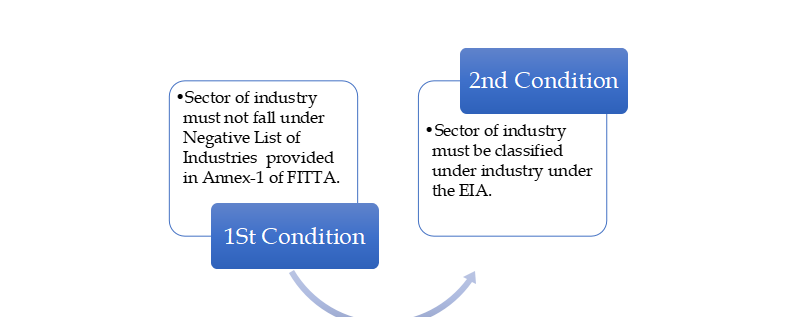
Foreign Investment is not permissible in every business. Following two conditions has to be fulfilled for the permissibility of FDI Companies in Nepal:
4. Industry where foreign investment is not permissible
Following are the industrial sector where foreign investment is not permissible:
- Poultry farming, fisheries, bee-keeping, fruits, vegetables, oil seeds, pulse seeds, milk industry and other sectors of primary agro-production;
- Cottage and small industries;
- Personal service business (hair cutting, tailoring, driving etc.);
- Industries manufacturing arms, ammunition, bullets and shell, gunpowder or explosives, and nuclear, biological and chemical (N.B.C.) weapons; industries producing atomic energy and radio-active materials;
- Real estate business (excluding construction industries), retail business, internal courier service, local catering service, moneychanger, remittance service
- Travel agency, guide involved in tourism, trekking and mountaineering guide, rural tourism including homestay;
- Business of mass communication media (newspaper, radio, television and online news) and motion picture of national language;
- Management, account, engineering, legal consultancy service and language training, music training, and computer training; and
- Consultancy services having foreign investment of more than fifty-one percent.
5. Procedure of foreign direct investment approval in Nepal:
The procedure of foreign investment approval is mentioned herein:

6. Minimum Capital Requirement For Foreign Investment in Nepal
The minimum capital required for obtaining foreign investment approval has been fixed as NPR 20 million (Approx. USD 153846).
7. Required Documents for FDI
Following are the documents required for registration of FDI Company in Nepal:
S.N. | Documents |
1. | Company incorporation certificate, Memorandum of Association and Article of Association of Investor (Notarized) |
2. | Copy of Passport in case of Individual Investor (Notarized) |
3. | Company profile of the investing company (Bio Data in case of individual investor)
|
4. | Copy of Passports all the Directors and shareholders of Investor (Notarized)
|
5. | Copy of passport/citizenship of Investor’s authorized representative (Notarized)
|
6. | Project report for operation of local subsidiary company
|
7. | Schedule for investment in industry
|
8. | Financial Credibility Certificate (FCC) of Investor issued by local bank in home country |
9. | Latest audit report of Investor (Notarized) |
10. | Resolution of Investor for investing in Nepal
|
11. | Signed company profile of the Investor
|
12. | Power of attorney authorizing the individuals to complete the approval and registration process.
|
13. | Joint Venture Agreement in case of two or more than two investors. |
8. Timeline for FDI approval process
The overall time period for the registration of foreign direction investment in Nepal takes about three to five (3 to 5) months.
9. Government Fee Applicable for FDI Approval Process
Government fee applicable for FDI approval in Nepal is as mentioned;
S.N. |
Particulars |
Government Fee | |
1. | Guarantee amount to be deposited at DOI. | NPR 20,000 (Approx. USD 155) | |
2. | Government fee for Company Registration | Depends on the authorized capital of company. | |
3. | Business Registration at Ward Office | NPR 5,000 to 15,000 per year (Approx. USD 38 to 115). Note: The business registration fees are specific to each local level. | |
4. | House Rent Tax | 10% of house rent amount per month (Please note house rent rate depends on each local level and subject to change every fiscal year). | |
10. Timeline for injecting the foreign investment amount in Nepal
FERA has categories 3 stages of timeline to inject the foreign investment amount. The schedule of investment as mentioned:
Stages | Details | Percentage of Injection of Investment |
Stage I | Within 1 year of receiving the investment approval: (Depends on the amount of investment)
i. Minimum investment amount i.e. NPR 20 Millions ii. 20 to 250 million NPR iii. 250 million NPR to 1000 Million iv. 1000 million and more
|
25 % 15% 10 % 5 % |
Stage 2 | When the company starts the production or does start the commercial transaction | Upto 70% of investment amount |
Stage 3 | After 2 years of production or commence of transaction | Remaining 30% of investment amount |
11. Sector Approval
Certain regulated businesses are also subject to additional business specific approvals or licenses for the commencement of their business activities even after getting FDI approval. Licensing/Approval requirement depends on the nature of business of company. Following are some business which requires additional specific approval before commencement of business activities:
S.N | Nature of Business | Institution to grant License/Approval |
1. | Colleges | Affiliated University |
2. | Insurance Company | Insurance Board |
3. | Bank and Financial Institution | Nepal Rastra Bank |
4. | Hydro Power | Electricity Development Board |
5. | Travels and Trek | Ministry of Tourism, Culture and Civil Aviation |
6. | Food Industries | Department of Food, Technology and Quality Control |
7. | Business related to telecommunication | Nepal Telecommunication Authority |
12. Capping of Foreign Investment
Foreign investors can invest 100% of ownership in local subsidiary companies. However, for few sectors the domestic law restrict investment through investment capping which are as mentioned:
Sector | Investment Percentage Ratio |
Telecommunication | 80% |
Banking and Financial Institution | Minimum 20% and Maximum 85% |
Insurance Companies | 80% |
Consultancy Business | 51 % |
13. Post investment compliances for FDI Company
Following are the main compliances that FDI company has to do after the FDI approval process:
- Submission of 3 months compliance document before OCR,
- Recording of investment at NRB,
- Submit Annual Compliance Document at OCR,
- Compliance with Companies Act, Labor Act, Tax Law and other applicable law of Nepal during the operation of the local subsidiary company.
14. Repatriation of foreign investment in Nepal
A foreign investor is allowed to repatriate the following:
- earnings through dividend or through sale proceeds against investment in shares,
- Compensation and Indemnity,
- Sale Proceeds upon Share Transfer,
- Returns of Capital at the Time of Liquidation,
- Technology transfer fees, royalty and license fees that have been earned through technology transfer and
- Lease rent under lease financing.
The investor has obligation to show that all local subsidiary company have complied all the laws, obtained all the necessary approval, pay tax and compiled with all the obligation before repatriation. Approval from DOI or IBN and NRB approval is required before repatriation. Investor can repatriate the investment and earning in the same currency or in other convertible foreign currency.
Related Article Link:
Please click the article published at our law firm website, which are related to the above article topic:
Registration of Company in Nepal
Registration of Branch Office of Foreign Company in Nepal
Registration of Liaison Office of Foreign Company in Nepal
Registration of Company Not Distributing Profit
Date of Publication: 18 August 2023
Disclaimer: This article published on our website is just for information purpose only. It shall not be taken as the legal advice, advertisement, personal communication, solicitation or inducement. Bhandari Law and Partners or any of the team members of the firm shall not be liable for the consequence arising of the information provided. The factual situation may be different on your case, thereof if you need further legal advice on the subject matter, please Contact Us.
Frequently Asked Questions
- What is the authority to regulate Foreign Direct Investment (FDI) in Nepal?
Following are the authorities that provides FDI approval based on the investment amount:
| Investment amount | Approving Authority |
| For NPR 6 billion or less | Department of Industry (“DOI”) |
| Above NPR 6 billion and Hydropower project more than 200 MW capacity | Investment Board of Nepal (“IBN”) |
- What is the permissibility requirement for FDI in Nepal?
The permissibility requirement for FDI in Nepal is as mentioned:
1st Condition: Sector of industry must not fall under Negative List of Industries provided in Annex-1 of FITTA and
2nd Condition: Sector of industry must be classified under industry under the IEA.
- What is the procedure of foreign investment approval in Nepal?
The process for foreign investment approval in Nepal is as mentioned:
Step 1: Obtaining the Foreign Investment Approval from DOI or IBN
Step 2: Registration of Company at Office of the Company Registrar
Step 3: Business registration at local ward office
Step 4: Obtaining the recommendation Letter from Ward Office for Industry registration
Step 5: Registration of Industry before Department of Industry
Step 6: Obtaining the “Non-blacklisted Certificate” from Credit Information Bureau
Step 7: Opening the local bank account of the Company
Step 8: Prior notification before injecting the investment amount
Step 9: Recording the investment amount before NRB
- What are the documents required for obtaining FDI approval in Nepal?
The documents that are required for obtaining FDI approval are as mentioned;
- Company incorporation certificate, Memorandum of Association and Article of Association of Investor (Notarized)
- Copy of Passport in case of Individual Investor (Notarized)
- Company profile of the investing company (Bio Data in case of individual investor)
- Copy of Passports all the Directors and shareholders of Investor (Notarized)
- Copy of passport/citizenship of Investor’s authorized representative (Notarized)
- Project report for operation of local subsidiary company
- Schedule for investment in industry
- Financial Credibility Certificate (FCC) of Investor issued by local bank in home country
- Latest audit report of Investor (Notarized)
- Resolution of Investor for investing in Nepal
- Signed company profile of the Investor
- Power of attorney authorizing the individuals to complete the approval and registration process.
- Joint Venture Agreement in case of two or more than two investors.
- What is the minimum capital requirement for FDI approval in Nepal?
The minimum capital required for FDI approval has been fixed as NPR 20 million (Approx. USD 153846).
- Timeline for the obtaining FDI registration?
The timeline for obtaining FDI registration in Nepal is usually three to five (3 to 5) months.
- What is the timeline for injecting the foreign investment amount in Nepal?
FERA has categories 3 stages of timeline to inject the foreign investment amount. The schedule of investment as mentioned:
| Stages | Details | Percentage of Injection of Investment |
| Stage I | Within 1 year of receiving the investment approval: (Depends on the amount of investment) a) Minimum investment amount i.e. NPR 20 Millions b) 20 to 250 million NPR c) 250 million NPR to 1000 Million d) 1000 million and more | 25 % 15% 10 % 5 % |
| Stage 2 | When the company starts the production or does start the commercial transaction | Upto 70% of investment amount |
| Stage 3 | After 2 years of production or commence of transaction | Remaining 30% of investment amount |
- Can a foreign investor invest 100% of ownership in Nepal?
Yes, foreign investors can invest 100% of ownership in local subsidiary companies. However, for few sectors the domestic law restrict investment through investment capping which are as mentioned:
| Sector | Investment Percentage Ratio |
| Telecommunication | 80% |
| Banking and Financial Institution | Minimum 20% and Maximum 85% |
| Insurance Companies | 80% |
| Consultancy Business | 51 % |
Frequently Asked Questions
| Investment amount | Approving Authority |
| For NPR 6 billion or less | Department of Industry (“DOI”) |
| Above NPR 6 billion and Hydropower project more than 200 MW capacity | Investment Board of Nepal (“IBN”) |
The permissibility requirement for FDI in Nepal is as mentioned:
1st Condition: Sector of industry must not fall under Negative List of Industries provided in Annex-1 of FITTA and
2nd Condition: Sector of industry must be classified under industry under the IEA.
The process for foreign investment approval in Nepal is as mentioned:
Step 1: Obtaining the Foreign Investment Approval from DOI or IBN
Step 2: Registration of Company at Office of the Company Registrar
Step 3: Business registration at local ward office
Step 4: Obtaining the recommendation Letter from Ward Office for Industry registration
Step 5: Registration of Industry before Department of Industry
Step 6: Obtaining the “Non-blacklisted Certificate” from Credit Information Bureau
Step 7: Opening the local bank account of the Company
Step 8: Prior notification before injecting the investment amount
Step 9: Recording the investment amount before NRB
The documents that are required for obtaining FDI approval are as mentioned;
– Company incorporation certificate, Memorandum of Association and Article of Association of Investor (Notarized)
– Copy of Passport in case of Individual Investor (Notarized)
– Company profile of the investing company (Bio Data in case of individual investor)
– Copy of Passports all the Directors and shareholders of Investor (Notarized)
– Copy of passport/citizenship of Investor’s authorized representative (Notarized)
– Project report for operation of local subsidiary company
– Schedule for investment in industry
– Financial Credibility Certificate (FCC) of Investor issued by local bank in home country
– Latest audit report of Investor (Notarized)
– Resolution of Investor for investing in Nepal
– Signed company profile of the Investor
– Power of attorney authorizing the individuals to complete the approval and registration process.
– Joint Venture Agreement in case of two or more than two investors.
The minimum capital required for FDI approval has been fixed as NPR 20 million (Approx. USD 153846).
The timeline for obtaining FDI registration in Nepal is usually three to five (3 to 5) months.
FERA has categories 3 stages of timeline to inject the foreign investment amount. The schedule of investment as mentioned:
| Stages | Details | Percentage of Injection of Investment |
| Stage I | Within 1 year of receiving the investment approval: (Depends on the amount of investment) a) Minimum investment amount i.e. NPR 20 Millions b) 20 to 250 million NPR c) 250 million NPR to 1000 Million d) 1000 million and more | 25 % 15% 10 % 5 % |
| Stage 2 | When the company starts the production or does start the commercial transaction | Upto 70% of investment amount |
| Stage 3 | After 2 years of production or commence of transaction | Remaining 30% of investment amount |
Yes, foreign investors can invest 100% of ownership in local subsidiary companies. However, for few sectors the domestic law restrict investment through investment capping which are as mentioned:
| Sector | Investment Percentage Ratio |
| Telecommunication | 80% |
| Banking and Financial Institution | Minimum 20% and Maximum 85% |
| Insurance Companies | 80% |
| Consultancy Business | 51 % |